
Benchmarks & Methodology
Our rule: we publish nothing we can't reproduce.
Every benchmark card or thread we post links back to this page. It contains the full method, the raw data, the exact scope of every claim — and the things we deliberately do not claim. If you think we got something wrong, tell us: we'll re-run the test and publish the result either way.
How we benchmark
- Defined scope, always. "Fast" means nothing without a definition. Every number we publish states exactly what was measured, over what sample, on what date.
- Distributions, not screenshots. One lucky trade proves nothing. We publish the median, the spread, and the win rate across the whole sample — nothing cherry-picked.
- Whole sample or no sample. Every data point collected for a test is included in the published result.
- We claim only what our data shows. One matchup, one metric, one sample at a time. No "fastest bot, period" claims — from us or about us.
- Public corrections. If a claim turns out to be wrong, we correct it in public, in the same channels where we made it.
Benchmark #1 — CopyTrade landing vs Trojan (June 2026)
The headline result
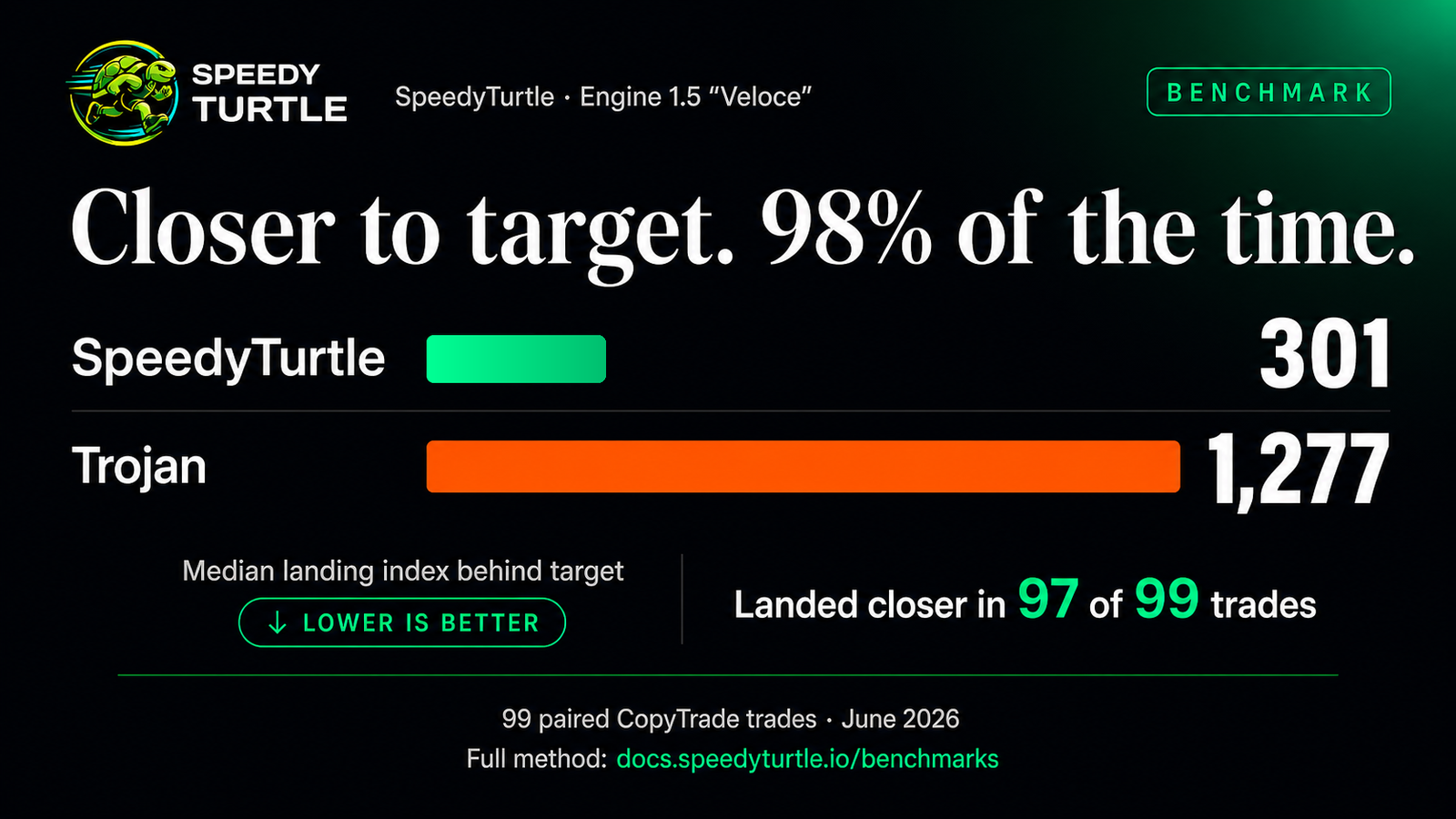
Across 99 paired copy trades of the same target wallet:
| Median landing gap (index positions) | |
|---|---|
| SpeedyTurtle | 301 |
| Trojan | 1,277 |
- Lower is better: a smaller gap means your copy landed closer to the trade you were copying.
- SpeedyTurtle landed closer to the target in 97 of 99 trades (~98%).
- The median gap was ~4.2× smaller (1,277 ÷ 301 ≈ 4.2).
Info
These numbers are index positions, not time. They count how many transaction positions behind the target trade each copy landed in the on-chain ordering. They are not milliseconds or any other unit of time.
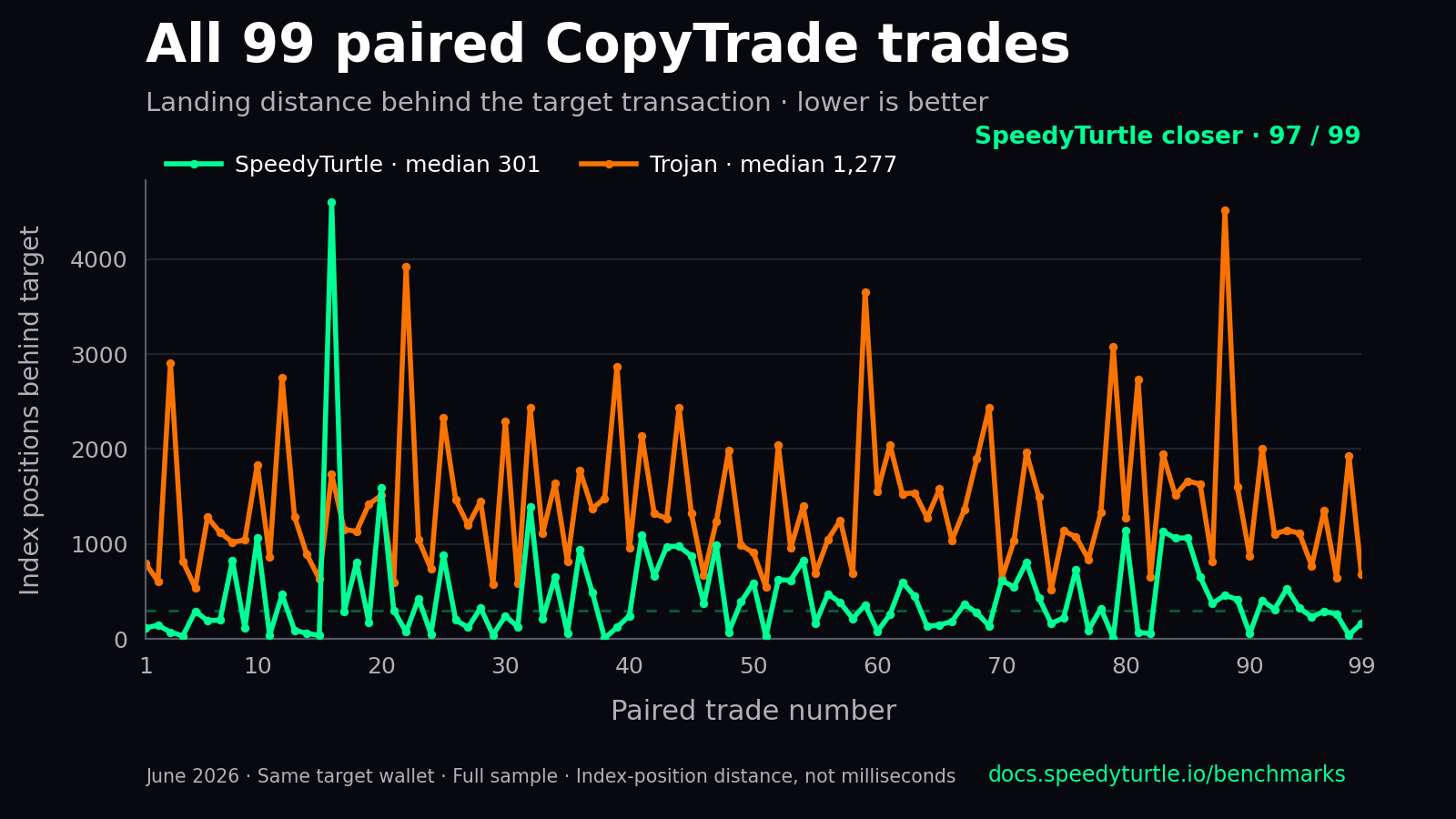
All 99 paired trades
What was measured — and why it matters
When you copy-trade, the wallet you follow gets a price, and your copy gets whatever price exists by the time it lands. Every position between the target's transaction and yours is another trade that can move the price against you. So for copy trading, the honest speed question isn't an abstract latency number — it's how close behind the target your copy actually lands on-chain.
The metric: for each trade the target wallet made, we take the on-chain ordering position (index) of the target's transaction and the index of each bot's copy transaction, as ordered by the block leader. The landing gap is the difference between them. On-chain ordering is public, so anyone can verify any pair from the transaction signatures.
Test setup
- Both SpeedyTurtle and Trojan were configured to copy-trade the same target wallet at the same time, with equivalent settings (same buy size and comparable fee configuration).
- A pair was counted whenever both bots executed a copy of the same target trade. All 99 pairs collected are in the published data — no filtering.
- Collection window: June 2026. Method and full results were published on June 6, 2026.
The data
- Original methodology thread (June 6, 2026): x.com/speedyturtle_io/status/2063283182766789007
- Full results with all 99 trades charted (June 6, 2026): x.com/speedyturtle_io/status/2063290575902924957
- Raw data for all 99 paired trades: docsend.com/v/yynz5/speedyturtle_se1_0_x_trojan
Reproduce it yourself
- Pick an active target wallet and configure two copy-trade bots to follow it with the same buy size and equivalent settings.
- Let both run over the same period. Keep every event where both bots landed a copy of the same target trade — no discarding pairs you don't like.
- For each pair, look up the on-chain ordering of the target transaction and both copy transactions (any explorer or RPC
getBlockshows the position of each transaction as ordered by the leader). - Compute the gap (copy index − target index) for each bot on each pair.
- Report the median, the full distribution, and the win rate over all pairs — with the raw signatures published.
Aim for a sample of at least 30 paired trades; single runs prove nothing in either direction. If you run this and get different results, send them to us — we'll look at them publicly.
Scope and limitations — what this does and doesn't show
- One matchup, one metric, one sample. This test compares SpeedyTurtle and Trojan on copy-trade landing gap over 99 paired trades in June 2026. It says nothing about other bots, other strategies, or other market conditions.
- The test is from June 2026 and ran on the SpeedyTurtle engine as it was in production then. We re-present it with the original publication linked; the numbers have not been re-run since.
- On-chain ordering has factors outside any bot's pipeline. Where a transaction lands depends on when it reaches the current block leader, which includes network path and validator topology — not just how fast a bot reacts. The test measures the end result users experience, not any single cause.
- Results vary. Different wallets, tokens, sizes, congestion levels, and fee settings will produce different gaps. The published distribution is what we measured under the stated conditions.
- Landing closer is not profit. A smaller gap means entries closer to the wallet you copy. It does not mean, and we never claim, that any strategy is profitable.
What we don't claim
- We don't claim to be "the fastest bot" — no one can verify a claim that broad, so we don't make it.
- We don't claim superiority over bots we haven't tested head-to-head. This page will grow as a series (further matchups are planned); each result gets published win or lose, with the same method and raw data.
- We don't convert index positions into time, and we don't publish latency figures without a defined measurement scope.
Challenge us
Skeptical? Good — that's the correct default in this market. Tell us what test would convince you and we'll run it: @speedyturtle_io on X, or our Telegram channel t.me/speedyturtle_io. If we got something wrong, we'll publish the correction.
Warning
Crypto trading carries significant risk. Benchmarks measure execution behavior, not trading outcomes. Nothing on this page is financial advice.
Documentation maintained by SpeedyTurtle Labs.